|
Sub-Topics
2006
MaterialsPapers
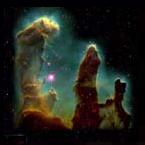
- Nebula, Eagle M16 (NASA)
Provides a picture of object M16, the Eagle Nebula, where stars are being born. 12-99
- Stars and Nebulae - Printable Pictures (NASA - Spaceplace)
Provides printable color pictures of stars, galaxies, and nebulae. Includes the Butterfly, Carina, Eagle, Hourglass, Eskimo, Orion, Stingray, Trifid, and the NGC3132 nebula. (The files are rather large and will take a while to load on a 56k modem.) Also spelled "nebulas." 9-01
- Crab Nebula (SEDS.org)
"The Crab Nebula is the most famous and conspicuous known supernova remnant, the expanding cloud of gas created in the explosion of a star as supernova which was observed in the year 1054 AD." Also spelled "nebulas." 01-06
- Emission Nebulae (Wikipedia.org)
"An emission nebula is a cloud of ionized gas (i.e. a plasma) emitting light of various colors. The most common source for ionization are high-energy photons emitted from a nearby hot star. Among the several different types of emission nebula are H II regions, in which star formation is taking place and young, massive stars are the source of the ionising photons; and planetary nebulae, in which a dying star has thrown off its outer layers, with the exposed hot core then ionizing them." Also spelled "nebulas." 01-06
- Emission Nebulae Pictures (NOAO.edu)
Provides over four dozen pictures. Also spelled "nebulas." 01-06
- Nebulae (Wikipedia.org)
"A nebula (Latin: "mist"; pl. nebulae) is an interstellar cloud of dust, gas and plasma. Originally nebula was a general name for any extended astronomical object, including galaxies beyond the Milky Way (some examples of the older usage survive; for example, the Andromeda Galaxy is sometimes referred to as the Andromeda Nebula)." Also spelled "nebulas." 01-06
- Nebulae of 2015 (Huffington Post)
"From stars shining over salt flats in Bolivia, to the Lagoon Nebula thousands of light-years from earth, the photos reveal a gorgeous and diverse array of astronomical phenomena from 2015." 07-15
- Orion Nebula Revealed in Pictures (MSNBC News)
"Scientists have created the most detailed portrait ever of the closest known star factory, the Orion Nebula. They have also uncovered new details about the stellar winds responsible for carving out the nebula's ghostly skyscapes." 01-06
- Questions About Nebulae (ASK and Astronomer for Kids)
Provides questions and answers for kids and adults. 01-06
- Reflection Nebulae (Wikipedia.org)
"In astronomy, reflection nebulae are clouds of dust which are simply reflecting the light of a nearby star or stars. The nearby star or stars are not hot enough to cause ionization in the gas of the nebula like in emission nebulae but are bright enough to give sufficient scattering to make the dust visible. Thus, the frequency spectrum shown by reflection nebulae is similar to that of the illuminating stars." Also spelled "nebulas." 01-06
- Types of Nebulae (NinePlanets.org)
"Originally, the word 'nebula' referred to almost any extended astronomical object (other than planets and comets). The etymological root of 'nebula' means 'cloud'. As is usual in astronomy, the old terminology survives in modern usage in sometimes confusing ways. We sometimes use the word 'nebula' to refer to galaxies, various types of star clusters and various kinds of interstellar dust/gas clouds. More strictly speaking, the word 'nebula' should be reserved for gas and dust clouds and not for groups of stars." Also spelled "nebulas." 01-06
- What Is a Nebula? (ASK and Astronomer for Kids)
"A nebula is a cloud of gas and dust in space. Some nebulas are regions where new stars are being formed, while others are the remains of dead or dying stars. Nebulas come in many different shapes and sizes. There are four main types of nebulas: Planetary nebulas, Reflection nebulas, Emission nebulas, and Absorption nebulas. The word nebula comes from the Latin word for cloud." Also spelled "nebulas." 01-06
|